Showing posts with label थे hindu. Show all posts
on Monday, August 1, 2011

Madras miscellany - A teaching university

As I had expected, there were several readers who were surprised by the fact that the University of Madras had been founded (in 1857) as only an examining — and degree-bestowing university and not as a teaching university as had been originally envisaged by Governor Lord Napier (Miscellany, July 25). When did it become a teaching university, many of them asked.

It was the Act of 1904 that insisted that the university should undertake teaching and research. The university then decided to start the Departments of History, Archaeology, Economics and Philology. But a shortage of funds as much as of persons qualified for professorships prevented it from opening the departments right away. Eventually, the Department of Economics was set up after the Government of India gave a special grant in 1912 to establish it. However, it was 1915 before it got a professor to chair it, Dr. Gilbert Slater, Principal of Ruskin College, Oxford, being appointed. The Department of Indian History and Archaeology followed, being set up in 1914, with Dr. S. Krishnaswami Ayyangar heading it. The Department of Comparative Philology was also set up in 1914 with the appointment of two lecturers. The Department started with courses in Sanskrit, Arabic and Persian, nurtured by Dr. Mark Collins of the University of Dublin. Tamil, Telugu, Malayalam and Kannada were added in 1927.

It was only after the late 1920s that other teaching disciplines were introduced in the university. With the addition of several new departments, more space became essential. Marine Villa, Thambu Villa, Limbdi Gardens, Moore's Garden and other buildings were taken on lease to meet the demand for space. Eventually, the Department Block, also called the Teaching Block and the Clock Tower Block, was built on the site of Marine Villa in Indo-Saracenic style — the handsome but ill-kept building nearest the Cooum — and was opened in 1935. The University of Madras could at last call itself a fully-equipped teaching university.

The raising of this and other buildings had been much delayed. On November 25, 1913, the Viceroy, Lord Hardinge, had laid the foundation stone for the additional buildings the university required. The Great War, and the years of recovery after it, pushed back these plans and it was only around a dozen years later that they were revived and the University of Madras got the buildings it needed.

******

An Indian celebration

My walking companion, just back from London, hasn't stopped talking about the Indian celebration he enjoyed in, arguably, the oldest Inns of Court where his grand-daughter got married recently. The bride wore a saree, the bridegroom was all booted and suited when they exchanged vows in the 17th Century Chapel of Lincoln's Inn, Later that evening, the reception was in Lincoln's Inn Hall — which is where my story today begins.

Waiting for the two young lawyers to arrive for the first dance — which they promised would be a surprise — my friend had time to gaze at the portraits of eminent lawyers and judges, alumni all, who graced the walls of the Hall. But then he was brought up short by a portrait of a person he'd known of in his Calcutta days and from his father's days as a cleric and an academic at Serampore College, that major Protestant seminary. It was a portrait of Bishop Heber, the Bishop of Calcutta which in the Bishop's day meant being the Anglican Bishop of India, Burma and Ceylon.

Even as he was wondering what the Bishop was doing on an Inns of Court walls, he was brought down to earth by the crashing notes of a tune he knew but never thought he'd hear in Lincoln's Inn's hallowed hall. And there were his sareed grand-daughter, her booted and suited husband and two other couples in garb the Hall was decidedly more used to all exuberantly flinging themselves about to Jai Ho! and getting the rest to join in the abandon of A.R. Rahman's creation. Lincoln's Inn had never seen anything like this — and “I wondered what M'Lords, Respected Counsels and the Bishop would have thought about this kind of celebration,” recalled my friend.

Back home, the Bishop hanging on the wall continued to bother him. Till we found that he had been Preacher of Lincoln's Inn from 1822 till his appointment as Bishop of Calcutta in 1823. The Preacher of Lincoln's Inn is apparently some kind of office of the Church of England, but why aren't the other Preachers up there, including John Donne who certainly would have appreciated the boisterousness of young love?

Heber, who wrote much poetry from his first days at Oxford and was best known for the hymns he wrote, is curiously remembered best in places with which he had the briefest of acquaintances, like Lincoln's Inn, Bishop Heber College, Trichinopoly, and Bishop Heber Hall, Madras Christian College. What was later named as the Heber Memorial School in Trichinopoly is where he drowned in his bath while passing through on his way back to Calcutta after a journey through India and Ceylon. When the Bishop Heber College that it became was closed, on its merger with Madras Christian College in 1934, Bishop Heber Hall (a hall of residence) and its Bishop Heber Chapel commemorated the merger and remembered a Bishop who had never visited the College. After much campaigning in Trichy, Bishop Heber College — that had been the first college in Trichy — was revived in 1966.

Bishop Heber will also be remembered for his hymn, ‘From Greenland's icy mountains, from India's coral strand…which had two lines which “stung” Gandhiji. The lines were “What though the spicy breezes blow soft o'er Ceylon's isle;/ Though every prospect pleases, and only man is vile?” After all that's happened in the island during the last 25 years, Gandhiji would probably still not agree with that assessment, but I am sure many others will.

******

When the postman knocked…

*Dr. Celia White states that Newtown (Miscellany, July 4 and July 11) is the Periamet area bounded by Vepery High Road, Naval Hospital Road, Poonamallee High Road and Perianna Maistry Street, with Wuthucatton Street in the middle. The area was a “stronghold of many Anglo-Indian families” and with it being close to General Hospital and St. Andrew's Church, it certainly seems possible that this is the New Town of the Smith-Anderson families.

*The first Indian Flight Deck Chief of the INS Vikrant, K.R.A. Narasiah, tells me that he remembers many of the fliers from 300 Squadron (the Seahawks) and 310 Squadron (the Cobras) (Miscellany, July 25). During his 1960-1963 tenure on the Vikrant — till he left the Navy — he was in charge of the catapult and arresting gear which launched and arrested Gannets as they prepared for the Alizés. He goes on to correct me about Mihir Roy's tenure with the Eastern Naval Command: “He may have been with the Command during the Bangladesh War, but it was Vice Admiral Krishnan who was in command; Mihir Roy succeeded him.”


Mind-mapping: expanding boundariyes

This edition of NetSpeak revisits the good old mind map technology and profiles a select set of on-line tools that help us adopt this technology in fresh grounds.

As you are well aware, the process of representing various facets of an idea or topic in a pictorial form is called mind mapping.

A mind map is a graphical representation of several concepts/tasks centred on a main theme or task.

A mind map helps us visualise different components of a project or a theme from a single easily comprehensible diagram — you get a bird's eye view of the project in one shot.

In addition, it lets you view multiple dimensions of your project/task in a non-linear fashion. The mind-map technology is used in diverse fronts such as project planning, exposition of ideas, developing business plan and so on.

The mind map technology is emerging to be yet another means to deliver/share information. In fact, a quick search on the Net will fetch numerous useful mind maps pertaining to the subject of your choice. The mind map, ‘Using the Internet to spice-up your math class' (http://goo.gl/54OY5), is a good example.

This resource-packed mind map features a huge collection of links pertaining to mathematics that include open-courseware, videos, on-line calculators and so on. The mind map ‘population and planet' (http://goo.gl/x9smU) that depicts the chain effects of population growth is yet another instance of a valuable mind map.

The availability of several free mind-mapping tools (http://www.thehindu.com/opinion/columns/j_murali/article963720.ece) has induced the popularity of this concept.

Apart from the tools discussed in the past, several new mind-applications continue to emerge. Mind42 (http://mind42.com/), an easy-to-use, collaborative mind-mapping application is one of such products encountered by NetSpeak in the recent past. The advantage of this application is that you can invite your collaborators and create mind maps with their active help.

Chrome users may find the extension Mind42 (http://goo.gl/xzGcQ) useful, as it helps them access the application directly from the browser.

The free on-line mind-map creation tool Spider Scribe (http://www.spiderscribe.net/) is yet another one of this kind tested by this author. Besides text content, Scribe maps can accommodate a variety of content items that include word documents, images and Google maps. This service also enables collaborative production of mind maps.

Literature on tool

An offshoot of this tilt towards the mind map technology is the development of new tools that incorporate mind-mapping features. The free software SciPlore MindMapping is an apt instance of this trend.

This product, which focuses on the academia, combines mind mapping with reference to management. The advantage of SciPlore lies in its ability to help a researcher manage literature and organise ideas with the help of mind map technology.

If the literature collection is stored in PDF documents the process becomes quite easy and the resulting mind map becomes rather enriched. The SciPlore MindMapping package enables one to create a mind map organising PDF documents quite meticulously. An advantage of this software is that when you link a PDF document to a node of the mind map, it automatically extracts bookmarks contained in the document and displays them as branches emanating from the node.

Another priced feature of this mind-mapping tool is that you can make it monitor a specific folder for files. This means, if you place a file in this folder, the software automatically detects it and displays it in the mind map. Besides PDF documents, the software detects files in formats such as DOC and RTF. And, in the case of PDF files, it automatically imports the bookmarks and make them part of the mind map tree. For details: http://sciplore.org/software /sciplore_ mindmapping/.

Google skills

As mentioned several times in this column, your ability to find information on-line quickly depends (to a large extent) on your skills to use Google. To help a user improve her Google skills, Google offers a slew of resources and applications (like the search puzzle service ‘Google a day', discussed in the past). To help you further sharpen your Google skills and keep up with the latest developments in the Web search realm, Google has started a blog called ‘Inside search' (http://insidesearch.blogspot.com/). It is likely that a regular ride on this blog could make you a better Web searcher.

SlideFinder

To help us find materials in a specific format (say PDF documents), popular search engines offer certain search commands. For instance, if your (Google) search intention is to obtain only PDF documents related to a keyword, you should use the command modifier ‘filetype:' (example: filetype:your-keyword). Yet another way to obtain documents of a certain genre is to enlist the service of a special search service that indexes only such documents. So if you need only PDF documents, look for a PDF search engine such as the PDF database (http://pdfdatabase.com/) mentioned in an earlier column. Now, if you are looking for PowerPoint presentations, a visit to the special service ‘Slide finder' (http://www.slidefinder.net/) might help.

Linux

There are umpteen ways to try Linux, the popular free, open-source operating system (like installing it on a virtual machine software like VirtualBox, discussed in the past — (http://www.hindu.com/biz/2009/09/21/stories/2009092150011300.htm). Now, if you wish to take a shot at Linux without having to install anything, then the on-line application ‘A PC Emulator in Javascript” (http://bellard.org/jslinux/) that runs a version of Linux inside your browser could come in handy. The application offers a clipboard facility that lets you transfer data to/from your machine to the Linux system running inside the browser too.


Dravid: Team wanted to protect spirit of the game

Veteran Indian batsman Rahul Dravid said it was a unanimous decision by the team to reinstate Ian Bell, who was run out in a bizarre manner, and protect the spirit of the game.

Dravid said the entire team had a chat during the tea break and they felt that Bell should be called back.

“Led by (Mahendra Singh) Dhoni, there was unanimity in the team that he (Bell) should be reinstated,” Dravid said.

“Under the rules he was out, but there was not a nice feeling in the dressing room. There was a bitter feeling in the stomach,” said Dravid.

“We thought that we would have felt bad had it happen to our player. In the series against West Indies, (VVS) Laxman was given out stumped when he dragged his feet that had left a bitter taste in the team. It can happen to anyone.

“There was a discussion in the dressing room and we knew it was not in the spirit of the game. There was unanimity that we should reinstate Ian and protect the spirit of the game. The team was led beautifully by Dhoni.

“We all discussed it and we were all behind the decision. We always try to play the game in the right spirit.”

The incident happened in the last ball before the tea; Morgan flicked Ishant Sharma to deep-square, where Praveen Kumar lunged to save the ball at the boundary rope. The fielder thought it was a four and so did the England batsmen. But it wasn’t.

Bell, who was leading England’s charge and batting at 137, casually left his crease thinking the ball had crossed the boundary and it was tea time. The ball was still in play and the umpires had not called tea.

The throw came back and the Abhinav Mukund took off the bails and India appealed for a run-out, much to the shock of English batsmen.

The field umpires after deliberation referred it to third umpire Billy Bowden, who after seeing that it was not a boundary, ruled in favour of India.

The mood in the England dressing room turned dark and sour as a bewildered Bell, clueless over his dismissal, and Morgan walked to the pavilion.

International Cricket Council (ICC) chief executive Haroon Lorgat was delighted by the way in which the situation was resolved.

“Absolute credit must go to Team India, the England team and the match officials — (match referee) Ranjan Madugalle, (on-field umpires) Asad Rauf and Marais Erasmus, as well as the off-field umpires Billy Bowden and Tim Robinson — for the superb way that they all handled a tricky situation,” Lorgat said.

“While the initial appeal and umpire decision may have been acceptable to the letter of the law, the decision by India captain M.S. Dhoni and his team — as well as the Team India coaching staff — to withdraw the appeal shows great maturity,” he said.

“To see players and officials uphold the great spirit of cricket, which has underpinned the game for more than a century, is very special. “I am indeed grateful for the way that the teams and match officials handled what was clearly a difficult situation and their behaviour reflects well on everyone.”


Senate rejects Democratic plan

Senate Republicans have blocked action on a Democratic approach to resolving the debt-ceiling crisis. It was a test vote largely unrelated to the talks between the White House and Congressional leaders on a compromise that can clear both the House and Senate.

The Senate voted 50-49 to clear a procedural hurdle toward consideration of a Bill put forth by Majority Leader Harry Reid. But 60 votes were needed to advance the measure.

The outcome of the vote on Sunday did not affect the effort to come up with a compromise that would avert a first-ever default in which the U.S. government would be unable to meet all its debt obligations.


Lok Sabha adjourned till tomorrow, uproar inRS

The Lok Sabha was on Monday adjourned for the day after paying tributes to former Haryana Chief Minister and sitting member Bhajan Lal, who died during the inter-session period. According to TV reports, uproarious scenes were witnessed in the Rajya Sabha over the government’s handling of the corruption issue.

As soon as the House met on the first day of the monsoon session of Parliament, Speaker Meira Kumar made obituary reference to Lal, a member from Hissar, who died on June 3.

She described him as an able administrator and champion of the causes of the masses and worked for the uplift of the weaker sections throughout his political career spanning over four decades.

The House also made obituary references to former members Dharmabhiksham, Sribatcha Digal, Sripal Singh Yadav, L S Tur and Chaturanan Mishra.

The House also mourned the loss of lives in twin attacks in Norway, the terrorist attack in Mumbai on July 13, train accidents at Thanagaon on July 7 and at Fatehpur, both in Uttar Pradesh, on July 10.

“I am sure the House would join me in expressing grief over these terrorist attacks and tragic accidents,” Kumar said.

The members observed silence for a while before the House was adjourned for the day.

Brief adjournment in RS

Main opposition BJP and other parties today forced a brief adjournment of the Rajya Sabha by creating uproar over several issues including the 2G spectrum scam.

Immediately after Chairman Hamid Ansari read out obituary references, BJP members were up on their feet raising the issue of statements made by former Telecom Minister A Raja in the court.

They were supported by members of AIADMK who displayed copies of a Tamil newspaper. BSP members raised the issue of farmers plight and were seen moving into the aisles.

Dr. Ansari said he could not hear anyone as members were speaking simultaneously.Minutes into the din, he adjourned the house for 15 minutes till 12 noon.


Ranjan Mathai assumes charge as Foreign Secretary

Veteran diplomat Ranjan Mathai on Monday assumed charge as new Foreign Secretary succeeding Nirupama Rao and said he would try and work to restore “trust and confidence” in Indo-Pak relations.

Mr. Mathai, a 1974-batch IFS officer, moved into his office in the Ministry of External Affairs in South Block at around 9.25 a.m. and assumed charge of the top post.

He said maintaining an era of constructive cooperation in the immediate neighbourhood will be one of his priority tasks as Foreign Secretary.

On Indo-Pak relations, 59-year-old Mathai, who will have a two-year fixed tenure, said the mandate for the Foreign Secretary is to pave the way for a substantive dialogue with Pakistan on all issues.

“We have to try and work to restore trust and confidence...This is the mandate which has been given to me.

Foreign Secretary is as much an institution as an individual.

So I will continue this effort,” he told reporters after taking charge.

“Continuity will be my watch word,” he said.

To a question whether composite dialogue is the “right way” between India and Pakistan, the Foreign Secretary said, “The mandate is substantive dialogue on all issues of common concern.”

Mr. Mathai, who has served in Indian missions in Vienna, Colombo, Washington, Tehran and Brussels, said India should develop “strong and cooperative relationship” with all global players.

“We need to keep in mind the need for very, very strong relations with countries in Latin America, Central Asia, South East Asia and the Gulf region,” he said.

Outgoing Foreign Secretary Nirupama Rao has been appointed India’s Ambassador to the United States.

Mr. Mathai said he was “greatly honoured” to take up the assignment which is a “very complex one and full of many challenges.”

“We are in a world of flux and we have to be innovative and adapt to the situation as it develops. But at the same time, we have to be clear about what are our national priorities and interests, many of which remain permanent,” he said.

In dealing with foreign policy challenges, Mr. Mathai said one has to take a holistic view of the political, strategic, economic, commercial, cultural and public aspects.

He said he would like to give “considerable priority” to public services dimension of the Ministry of External Affairs like passport and consular services.

“I think this is an area that needs particular importance,” he said.

He said the Ministry has to be administered according to the regulations and there is a management system which has to be addressed while keeping in mind the morale of the personnel.

After completing post graduate studies in political science at the University of Poona, Mr. Mathai joined the Indian Foreign Service in 1974.

As Joint Secretary in the Ministry of External Affairs in New Delhi between January 1995 and February 1998, he headed the division dealing with India’s relations with Bangladesh, Sri Lanka, Myanmar and Maldives.

He also served as Indian Ambassador to Israel from February 1998 to June 2001 and was the Indian envoy in Qatar from August 2001 to July 2005.

He held the post of Deputy High Commissioner of India in the UK from August 2005 to January 2007.


on Sunday, July 31, 2011

Deal agreed to prevent U.S. default

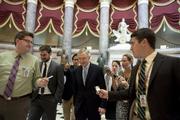
Republicans and Democrats in Congress reached agreement with President Barack Obama to raise the limit on U.S. borrowing and forestall an unprecedented American default, marking the start in the final chapter of one of the nastiest and divisive episodes in recent American political history.

Shortly after Senate Majority Leader Harry Reid and his Republican counterpart, minority leader Mitchell McConnell, endorsed the plan on the Senate floor, Mr. Obama went to the White House press room to add his support for the deal. It meets one of his key demands, raising borrowing power sufficiently to keep the partisan poison pill from returning to the national agenda until after the 2012 election. It does not include any tax increases that Mr. Obama had pressed hard for to include.

House Speaker John Boehner, in a conference call with Republican members of the lower chamber, said the deal was a good one that met the demands of all Republicans.

Bowing to the still unknown outcome of congressional action, Mr. Obama said important votes remained to be taken but that leaders of both parties in both houses of Congress were agreed to a plan that would initially cut about $1 trillion from U.S. spending, “the lowest level of domestic spending since Dwight Eisenhower was president” in the 1950s.

“Is this the deal I would have preferred,” Mr. Obama asked, answering his own question with one word. “No.”

But he said- “Most importantly it will allow us to avoid default and end the crisis that Washington imposed on the rest of America. And it will allow us to lift the cloud of doubt and uncertainty” that has hung above the United States for weeks.

And not just America- World markets showed their relief immediately. Japan’s benchmark Nikkei index, opening Monday morning -- at 8 p.m. Sunday on America’s East Coast -- was up 1.7 percent in early trading. On Wall Street, U.S. stock futures surged.

No votes were expected in either house of Congress until Monday at the earliest, to give rank and file lawmakers to review the package. Tuesday is the deadline to avoid a U.S. default on payments to investors in Treasury bonds, recipients of Social Security pension checks, those relying on military veterans benefits and businesses that do work for the government.

Mr. Obama and many economists and financial experts predicted global chaos and plunging stock markets had no deal been reached by midnight Tuesday.

If approved in Monday votes, the compromise would presumably preserve America’s sterling credit rating, reassure investors in financial markets across the globe and possibly reverse the losses that spread across Wall Street in recent days as the threat of a default grew.

The broadest outlines of the emerging plan, a deal that involved deep negotiations between McConnell and Vice President Joe Biden, would raise the federal debt limit in two stages by at least $2.2 trillion, enough to tide the Treasury over until after the 2012 elections.

Big cuts in government spending would be phased in over a decade. Thousands of programs -- the Park Service, Internal Revenue Service and Labor Department accounts among them -- could be trimmed to levels last seen years ago.

No benefit cuts were envisioned for the Social Security pension system or Medicare, the federal program that provides health care payments to the elderly. But other programs would be scoured for savings. Taxes would be unlikely to rise.

The first step would take place immediately, raising the debt limit by nearly $1 trillion and cutting spending by a slightly larger amount over a decade.

That would be followed by creation of a new congressional committee that would have until the end of November to recommend $1.8 trillion or more in deficit cuts, targeting benefit programs such as Medicare, Medicaid and Social Security, or overhauling the tax code. Those deficit cuts would allow a second increase in the debt limit, which would be needed by early next year.

If the committee failed to reach its $1.8 trillion target, or Congress failed to approve its recommendations by the end of 2011, lawmakers would then have to vote on a proposed constitutional balanced—budget amendment.

If that failed to pass, automatic spending cuts totalling $1.2 trillion would automatically take effect, and the debt limit would rise by an identical amount.

Social Security, Medicaid and food stamps would be exempt from the automatic cuts, but payments to doctors, nursing homes and other Medicare providers could be trimmed, as could subsidies to insurance companies that offer an alternative to government—run Medicare.

Any agreement will have to be passed by the Democratic—controlled Senate, which was seen as assured, and Republican—controlled House, which still could face a major tussle, before going to the White House for Mr. Obama’s signature. With precious little time remaining, both chambers had been on standby throughout the day Sunday.

Some Republicans were said to still be balking over proposed cuts in defence spending. It also was unclear how the 87 new House members, voted in with support from the low—tax, small—government tea party wing of the Republican Party, would vote. But it was believed that both Boehner, the Republican House speaker, and Reid, leader of majority Democrats in the Senate, felt certain they could garner sufficient votes.

The coming days will be clogged with statements from both Republicans, especially the tea party caucus, and Democrats as they try to convince their constituencies that they held firm and won the day in the bitter divide over how the government operates and what it owes to its citizens.